 Corporate Events Blogs
Corporate Training Activations
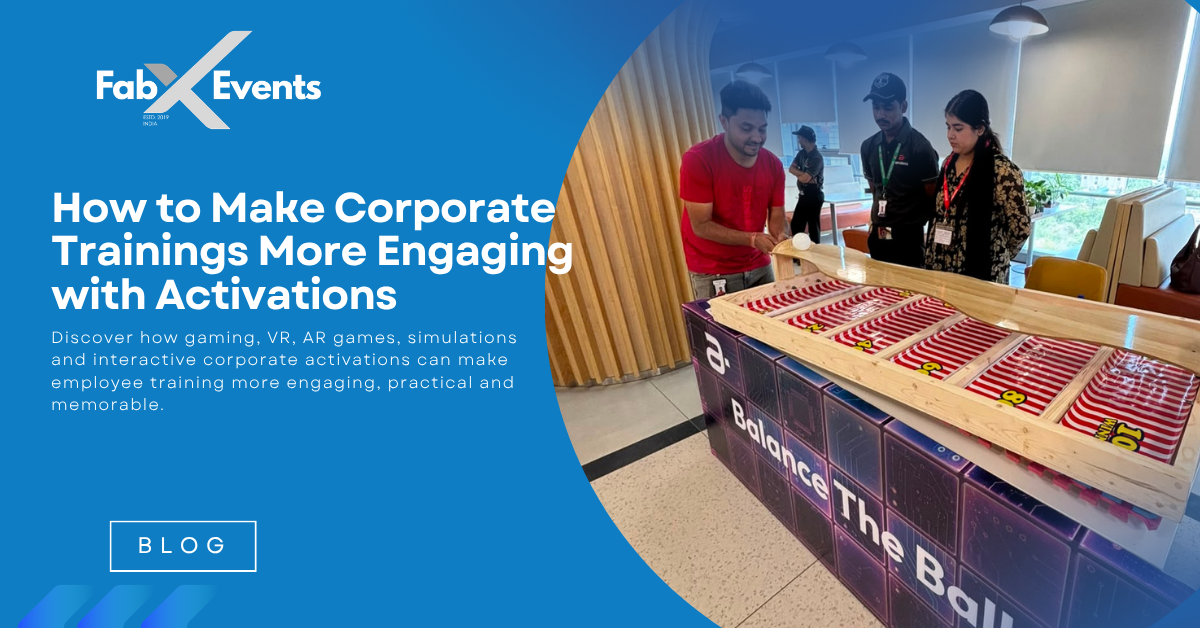
Discover how gaming, VR, AR games, simulations and interactive corporate activations can make employee training more engaging, practical and memorable.
How to Make Corporate Trainings More Engaging with Activations
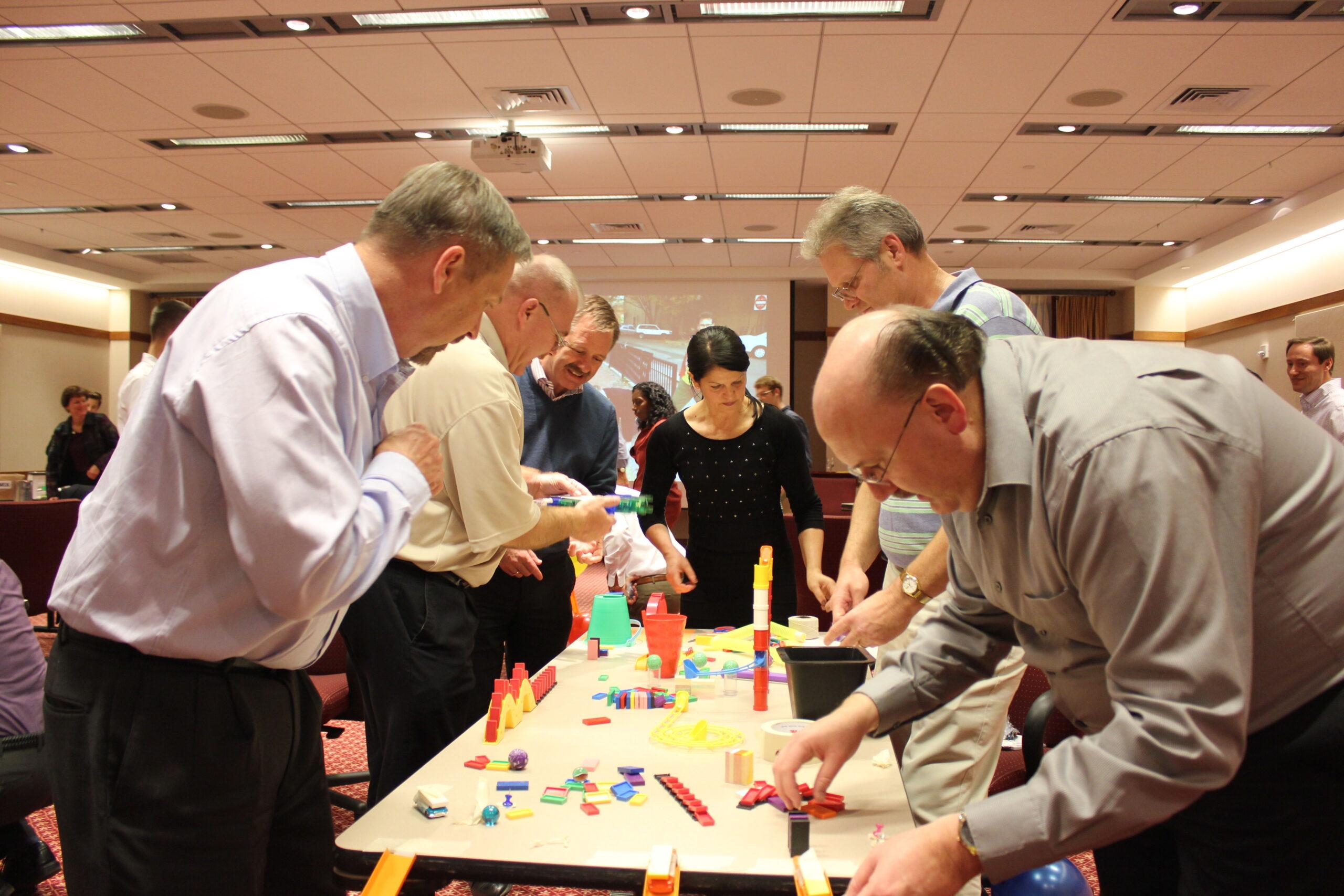
Corporate training has changed significantly. Employees are no longer expected to learn everything through presentations, lectures, manuals, and long classroom sessions. Modern workplace learning increasingly focuses on participation, practical application, collaboration, feedback, and experiences that employees can remember and apply.
This is where corporate activations can add a new dimension to learning.
Instead of simply explaining a concept, an activation can ask employees to solve a challenge, compete with colleagues, enter a simulation, make decisions, explore a virtual environment, or work together toward a common objective. Gaming, VR, AR, simulations, interactive challenges, and even simple physical activities can transform a conventional training programme into a more engaging learning experience.
Research on workplace gamification supports this direction, although the results depend heavily on how well the experience is designed and connected to the learning objective. Recent research has associated well-designed gamification with stronger engagement, motivation, knowledge retention, collaboration, and learning outcomes.
The important idea is simple: training should not become entertainment for the sake of entertainment. The experience should help employees learn, practise, collaborate, make decisions, and understand how the lesson applies to their work.
Why Traditional Corporate Training Can Feel Repetitive
Corporate training often has an unavoidable information-heavy component. Employees may need to understand company policies, product information, safety procedures, compliance requirements, leadership principles, sales techniques, or new technologies.
The problem is not necessarily the information. It is often the way that information is delivered.
A presentation can explain how employees should respond to a workplace situation, but an interactive scenario can allow them to actually make the decision. A product lecture can describe features, while a game can challenge participants to identify the right product for a particular customer. A safety presentation can list potential hazards, while a simulation can place employees inside a realistic environment where they must identify and respond to them.
This changes employees from passive recipients into active participants.
A well-designed training activation follows a different learning journey:
Learn → Participate → Experience → Make a decision → Receive feedback → Reflect → Apply.
That makes the training session more memorable and gives facilitators opportunities to discuss why participants made particular choices.
What Are Corporate Training Activations?
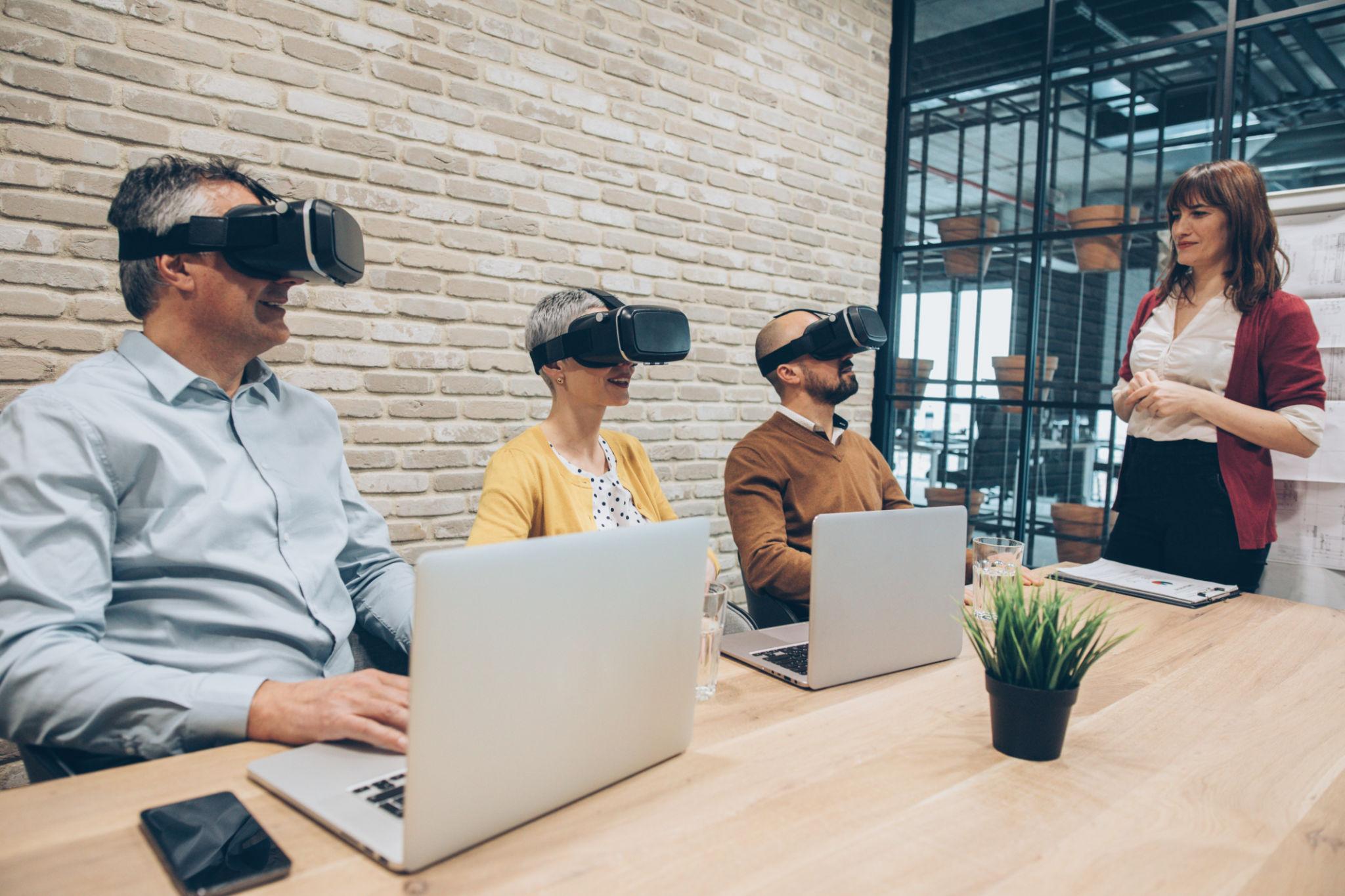
Corporate training activations are interactive experiences designed around a specific learning, behavioural, communication, or team-development objective.
They can range from simple physical games and quizzes to advanced VR simulations, AR challenges, interactive installations, escape-room formats, and business simulations.
For example, a company conducting cybersecurity training could create a simulated cyber incident in which teams have to identify suspicious activity, prioritize actions, communicate with stakeholders, and protect critical information.
Similarly, a leadership programme could place participants in a fictional business crisis where they must divide responsibilities, resolve disagreements, manage limited information, and make decisions within a fixed time.
The activation becomes the environment in which learning happens.
Start With the Training Objective, Not the Technology
One of the biggest mistakes companies make is selecting an impressive technology first and trying to find a training purpose for it later.
The better approach is the opposite.
Start by asking:
What should employees know after the session?
What behaviour should change?
What decision-making skill should improve?
What situation should employees practise?
What should participants remember a week or a month later?
Once these questions are clear, the appropriate activation can be selected.
If the objective is collaboration, a team challenge may work better than an individual VR experience. If the objective is safety awareness, VR may provide a realistic environment for practising hazard recognition. If the objective is product knowledge, an interactive quiz or AR product challenge could be more appropriate.
Technology should support the learning objective rather than become the objective itself.
Gaming Activations for Corporate Training
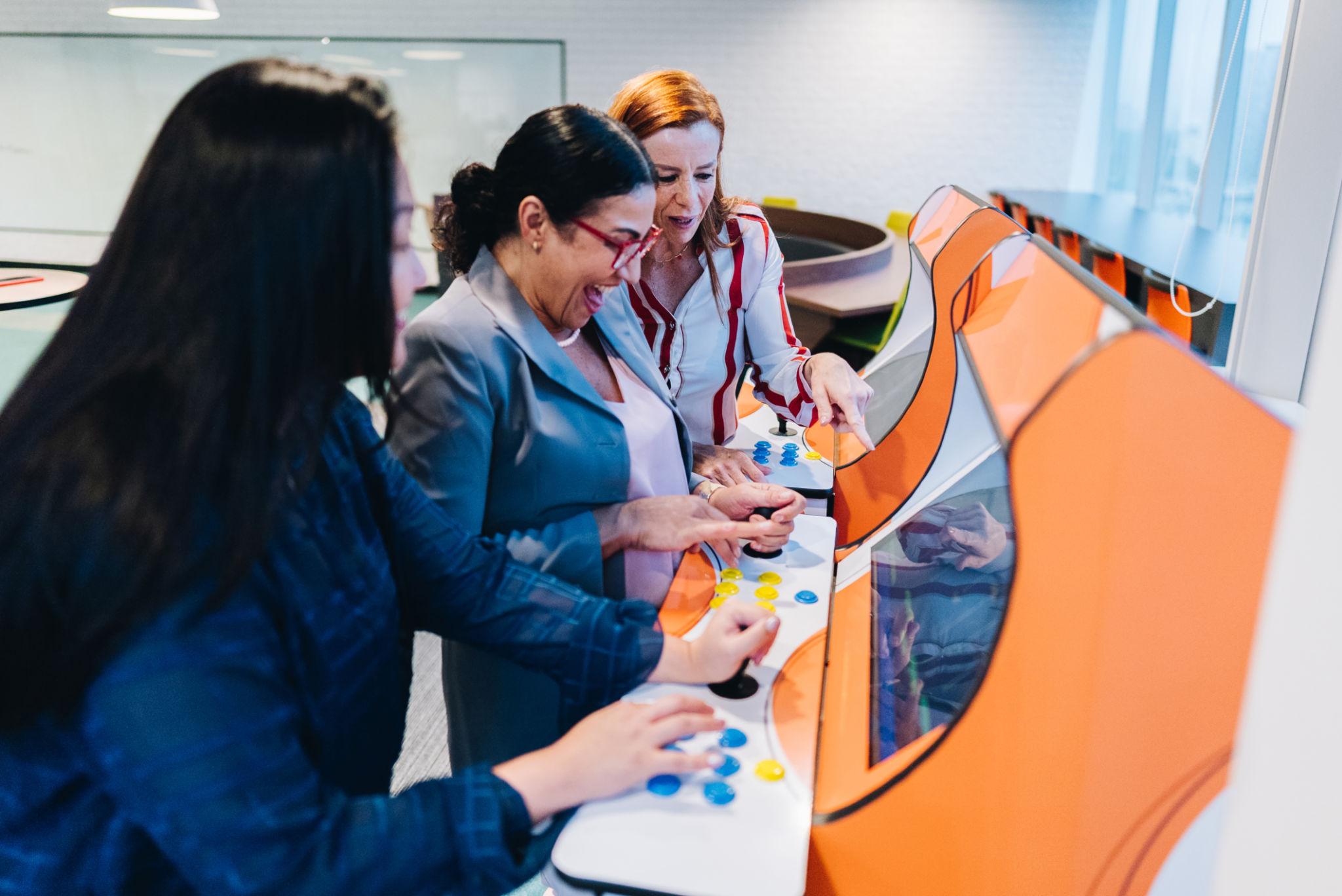
Gaming is one of the easiest ways to introduce energy, participation, competition, and feedback into a training programme.
A corporate quiz battle, for example, can turn product knowledge or compliance revision into a fast-paced team competition. Participants answer questions, earn points, and immediately see the consequences of their choices.
More sophisticated formats can involve business simulations where teams manage pricing, sales, operations, resources, or customer relationships.
Escape-room-style challenges are another option. Employees receive a series of clues connected to the training subject and must collaborate to solve them within a fixed period.
The most effective gaming activations are not simply entertaining. Their rules and challenges are directly connected to the lesson.
For example, a sales training game could require teams to identify customer needs, select suitable products, handle objections, and close a fictional deal. A leadership challenge could reward communication, delegation, prioritization, and problem-solving rather than simply speed.
Recent workplace research indicates that gamification can support engagement and learning, but its effectiveness is influenced by design quality, context, participant characteristics, and organisational culture.
VR Activations for Immersive Corporate Training
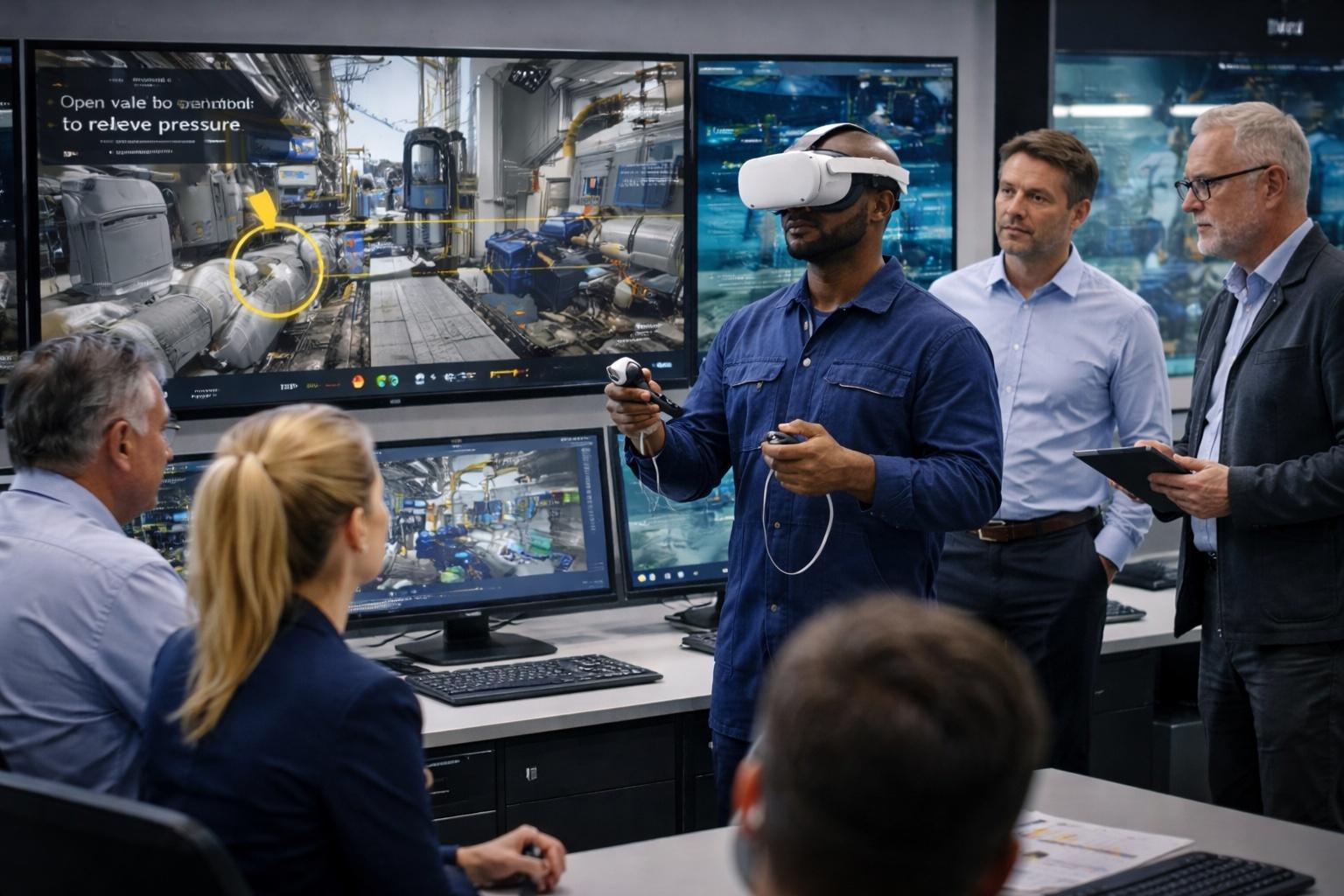
Virtual reality can take corporate training into situations that are difficult, expensive, risky, or impractical to recreate physically.
With VR, employees can enter a simulated environment and practise responses rather than simply hearing instructions.
Imagine a safety training session where employees put on a headset and enter a virtual factory floor. They may have to identify hazards, choose the correct response, and react to an emergency.
The same principle can be applied to:
- Workplace safety
- Emergency response
- Equipment familiarisation
- Factory and plant walkthroughs
- Customer service
- Sales conversations
- Leadership scenarios
- Crisis management
- Public speaking
- Workplace induction
- Healthcare and procedural training
VR on rent can also make immersive training more practical for companies that want to use VR during a specific workshop, conference, employee engagement programme, or training day without making a permanent hardware investment.
The value of VR comes from the experience it creates. A participant is not merely watching a video about a workplace situation; they are placed inside a simulated environment where they have to pay attention and act.
AR Games Can Turn the Workplace Into a Learning Environment
Augmented reality offers a different approach.
Rather than taking employees into a completely virtual environment, AR can add digital information and challenges to the physical world.
An organisation could create an office-wide learning challenge in which participants scan markers placed around different areas. Each marker could reveal a question, product detail, video, clue, or mini-game.
A training programme could become a treasure hunt where employees move through different stations to complete challenges.
For product training, employees might scan a product or packaging element to reveal information about its features. For onboarding, AR could guide new employees through an interactive office journey.
This approach is particularly useful when the company wants employees to move, communicate, collaborate, and explore.
Simulations Make Learning More Practical
Simulation-based training is powerful because it creates a controlled environment in which employees can experiment.
A customer-service simulation could present an increasingly difficult customer conversation.
A management simulation could introduce conflicting priorities between employees.
A sales simulation could change the customer's response based on what the participant says.
A crisis-management exercise could introduce new information every few minutes, forcing teams to reconsider their strategy.
The benefit is that employees can practise without exposing the organisation or its customers to the consequences of an actual mistake.
The facilitator can then pause the experience, review the decisions, and connect them to real workplace practices.
Turn Team Building Into Learning
Team building and corporate training do not always need to be separate activities.
A well-designed activation can develop teamwork while simultaneously reinforcing a business objective.
For example, teams could receive a simulated business problem and have 30 minutes to create a solution. Each participant could receive different information, requiring the group to communicate effectively.
Another format could involve a physical challenge where participants have limited resources and must decide how to allocate them.
The goal is not simply to determine which team wins. The facilitator should examine how the teams communicated, delegated responsibilities, handled disagreement, and responded to pressure.
This turns the activity into a practical team-development exercise.
Game-Show Formats for Training
Game-show training can bring energy to topics that might otherwise feel repetitive.
Imagine transforming a compliance session into a fast-paced quiz competition. Employees could compete individually or in teams, answer scenario-based questions, and receive immediate explanations after each response.
The format can be adapted to product knowledge, company policies, sales training, cybersecurity, workplace safety, onboarding, or general knowledge.
The advantage is that the training room becomes participatory.
Instead of asking, "Does everyone understand?", the facilitator can observe how participants respond to realistic questions and identify areas that require further explanation.
AI-Powered Training Experiences
AI can add another layer of interaction to experiential training.
An AI-powered character can simulate a customer, manager, interviewer, patient, colleague, or other workplace persona.
For example, employees participating in sales training could practise conversations with a simulated customer. The customer could respond differently depending on the participant's approach.
Similarly, a leadership workshop could use simulated workplace conversations involving conflict resolution, feedback, delegation, or performance discussions.
AI should not replace the trainer. Instead, it can provide additional opportunities for practice before the facilitator discusses the experience with the group.
Photobooths and Creative Activations Can Support Corporate Events
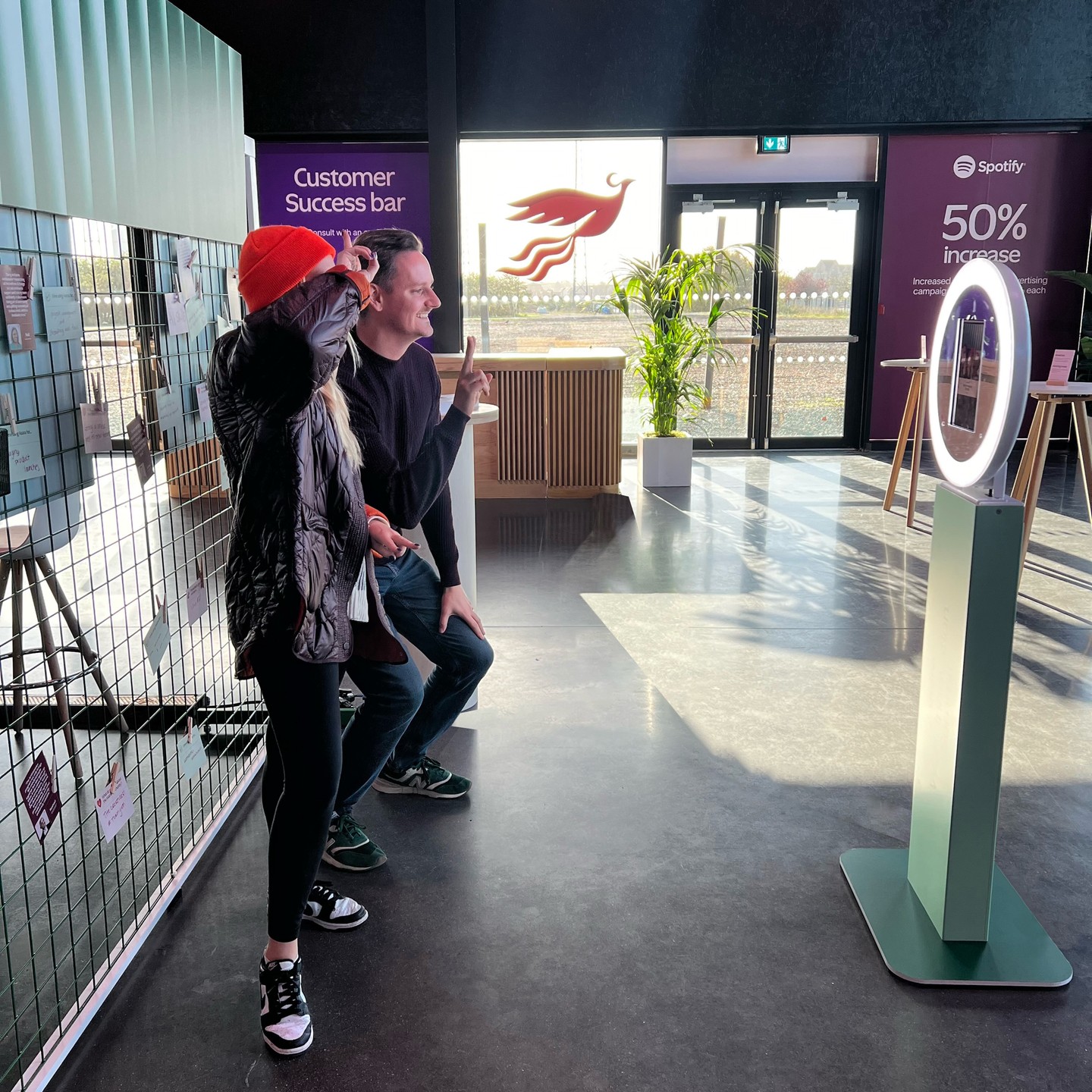
Not every activation has to be directly instructional.
A photobooth can be useful during corporate conferences, employee days, annual meetings, product launches, and training events as an engagement and memory-building element.
For example, an AI photobooth could create themed employee portraits around a company's future vision, innovation theme, leadership programme, or campaign concept.
While this may not teach a technical skill by itself, it can create social interaction, encourage participation, and generate content around the event.
The key is understanding the role of the activation. Some experiences teach. Others energize participants, create networking opportunities, reinforce brand identity, or make the overall event more memorable.
How to Design an Effective Training Activation
A successful activation should begin with a clear learning objective.
Next, define the participant journey. Determine what employees will see, what they need to do, what decisions they will make, and what feedback they will receive.
The experience should then be tested before deployment. A technically impressive activity can still fail if instructions are confusing, queues are too long, the challenge is too difficult, or participants cannot understand the connection to their work.
Facilitators are particularly important.
After the activity, employees should have an opportunity to discuss what happened. Why did they make certain decisions? What worked? What failed? How would the situation be handled at work?
This debrief converts an entertaining activity into a learning experience.
How to Measure the Success of Training Activations
The success of experiential training should not be measured only by participation numbers.
Companies can evaluate:
- Participation and completion rates
- Knowledge assessment scores
- Scenario performance
- Decision-making accuracy
- Team collaboration
- Participant feedback
- Knowledge retention
- Behavioural changes
- Application of skills after training
- Training satisfaction
Where appropriate, pre-training and post-training assessments can help determine whether participants actually improved.
Research also suggests that gamification can produce positive learning outcomes, but results are not universally guaranteed. Good instructional design and contextual fit remain essential.
Common Mistakes to Avoid
The first mistake is choosing technology simply because it looks impressive.
The second is making the activity too complicated. Employees should understand what they need to do without spending most of the session learning the equipment.
Another mistake is focusing entirely on competition. Leaderboards and prizes can motivate some participants but may discourage others. Cooperative challenges can sometimes be more appropriate.
Finally, companies should avoid ending the experience immediately after the game. Without reflection and discussion, participants may remember the activity but forget the learning objective.
The Future of Experiential Corporate Training
Corporate learning is moving toward more active and flexible formats. Gamification, simulations, VR, AR, AI, interactive games, and physical challenges can complement conventional instruction and provide employees with more opportunities to practise.
The strongest programmes will not necessarily be the ones using the most advanced technology. They will be the ones that understand the participant, the business problem, and the desired learning outcome.
A simple team challenge can be more effective than an expensive VR installation if collaboration is the goal. Similarly, VR may be the better choice when employees need to practise a dangerous or difficult-to-recreate situation.
The future is therefore not about replacing traditional training. It is about combining the right methods.
Conclusion
Making corporate training more engaging does not mean turning every workshop into a game.
It means giving employees more opportunities to participate, practise, decide, collaborate, receive feedback, and connect learning with real situations.
Corporate activations can provide that bridge.
Gaming can introduce competition and problem-solving. VR can create immersive simulations. AR games can turn physical spaces into interactive learning environments. Simulations can provide realistic practice. Team challenges can strengthen collaboration. AI can create dynamic role-play scenarios, while creative experiences such as photobooths can add social energy to corporate events.
The most important principle remains simple:
Don't begin by asking, "What technology should we use?"
Begin by asking, "What should employees learn or do differently after this training?"
Once that answer is clear, the right activation becomes much easier to design.
When learning is designed as an experience rather than simply a presentation, employees have more opportunities to participate in it, remember it, and ultimately apply it at work.
Author Bio
Khushboo is a hospitality professional with over 12 years of experience and a degree in Hospitality. As the Corporate Sales Lead at FabX Events, She works closely with businesses, event organisers, and enterprises to provide the right technology rental solutions for conferences, exhibitions, training programmes, corporate events, and business projects. Passionate about technology and event innovation, Khushboo stays up to date with the latest hardware trends and shares practical insights, industry best practices, and expert advice through the FabX Events blog.
FAQs