 Corporate Brand Activations
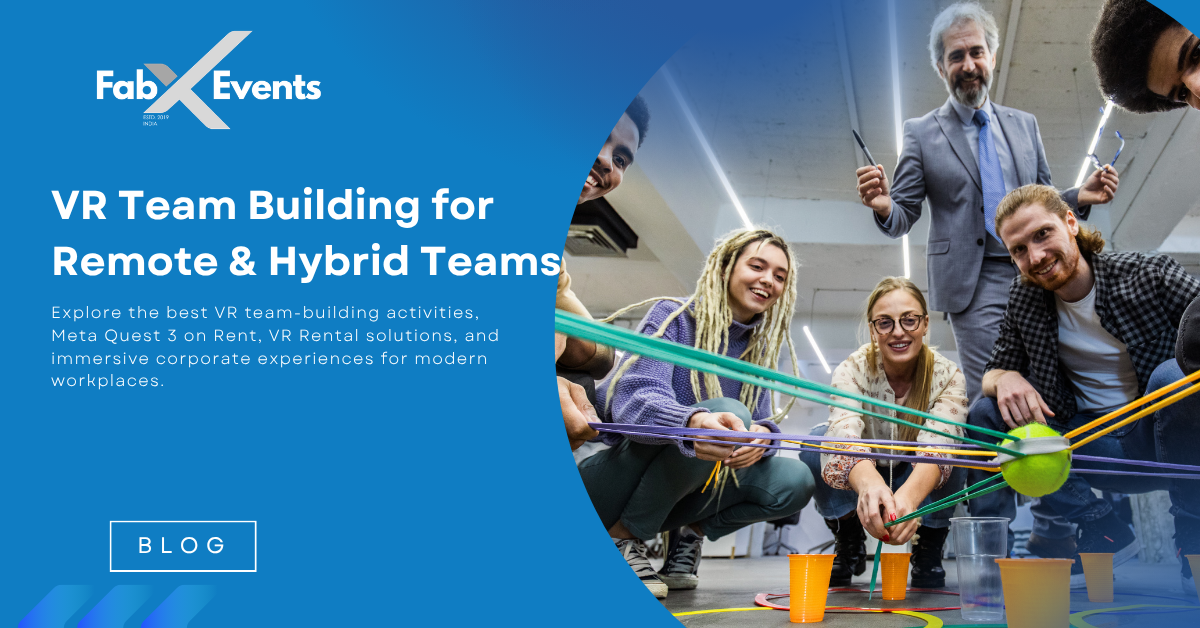
VR Team Building for Remote & Hybrid Teams
Discover how VR Team Building helps remote and hybrid teams improve collaboration, engagement, and communication. Explore the best VR team-building activities, Meta Quest 3 on Rent, VR Rental solutions, and immersive corporate experiences for modern workplaces.
VR Team Building for Remote & Hybrid Teams: What Actually Works?
The workplace has changed dramatically over the past few years. Remote work, hybrid offices, and distributed teams have become the norm for organizations across technology, finance, consulting, healthcare, education, manufacturing, and many other industries. While these flexible work models have improved productivity and expanded access to global talent, they have also introduced a new challenge—keeping employees connected.
Teams that rarely meet in person often miss the spontaneous conversations, informal brainstorming sessions, and social interactions that naturally build trust and collaboration. Video conferencing platforms have made communication easier, but they often struggle to recreate the energy and engagement of face-to-face interactions.
This is where Virtual Reality (VR) is changing the way organizations approach employee engagement.
Instead of interacting through flat screens, VR allows employees to meet inside shared virtual environments where they can collaborate, communicate, solve challenges, and participate in immersive experiences together—regardless of their physical location.
As organizations continue investing in the future of work, VR Team Building has emerged as one of the most innovative ways to strengthen collaboration among remote and hybrid teams.
In this guide, we'll explore what actually works, the benefits of VR team-building experiences, common use cases, implementation strategies, and how businesses can leverage VR Rental, Meta Quest 3 on Rent, and immersive collaboration platforms to create meaningful employee experiences.
Why Team Building Has Become More Challenging
Traditional offices naturally encouraged collaboration.
Employees interacted while walking between meetings, during lunch breaks, at coffee stations, or while solving everyday workplace challenges together.
Remote work removed many of these spontaneous interactions.
As a result, organizations frequently face challenges such as:
- Reduced employee engagement
- Communication gaps
- Lower team cohesion
- Limited cross-functional collaboration
- Difficulties onboarding new employees
- Employee isolation
- Virtual meeting fatigue
- Reduced sense of belonging
Conventional online meetings help teams communicate but rarely recreate the human connection that drives strong workplace culture.
What Is VR Team Building?
VR Team Building uses Virtual Reality technology to bring employees together inside shared digital environments where they interact using avatars and participate in collaborative activities.
Unlike video calls, VR creates a stronger sense of presence by allowing participants to move naturally, communicate spatially, manipulate virtual objects, and solve challenges together.
The goal isn't simply entertainment—it is to improve collaboration, communication, trust, and engagement through shared experiences.
Rather than replacing existing collaboration tools, VR complements platforms like Microsoft Teams, Zoom, Slack, and Google Meet by providing a highly interactive environment for team engagement.
Why VR Works Better Than Traditional Virtual Meetings
Standard virtual meetings often encourage passive participation.
Participants turn off cameras, multitask, or disengage during long discussions.
Virtual Reality changes this dynamic by making employees active participants.
Key Advantages
Greater Sense of Presence
Employees feel as though they are sharing the same physical space.
Improved Collaboration
Interactive environments encourage teamwork instead of passive observation.
Better Engagement
Gamified experiences naturally increase participation.
Stronger Communication
Body language, gestures, and spatial audio improve conversations.
Enhanced Knowledge Retention
People remember experiences more effectively than presentations.
What Actually Works in VR Team Building?
Not every VR activity produces meaningful business outcomes.
Successful programs balance entertainment with collaboration and organizational objectives.
1. Virtual Escape Rooms
Escape rooms remain one of the most effective VR team-building experiences.
Teams work together to:
- Solve puzzles
- Decode clues
- Manage time
- Share information
- Make decisions collaboratively
These experiences naturally improve communication and problem-solving.
2. Multiplayer VR Challenges
Competitive and cooperative multiplayer games encourage collaboration while keeping participants engaged.
Popular experiences include:
- VR Cricket
- Beat Saber Team Challenges
- Multiplayer Adventure Games
- Cooperative Action Games
- Virtual Sports Competitions
These activities are ideal for employee engagement events and corporate offsites.
3. Collaborative Problem-Solving Simulations
Organizations increasingly use VR simulations to recreate realistic workplace scenarios.
Examples include:
- Crisis management
- Manufacturing workflows
- Customer service scenarios
- Engineering collaboration
- Project planning exercises
These simulations strengthen teamwork while supporting professional development.
4. Creative Workshops
VR is not limited to gaming.
Creative collaboration can include:
- Virtual whiteboarding
- 3D brainstorming
- Design thinking sessions
- Innovation workshops
- Interactive presentations
Creative environments encourage fresh perspectives and active participation.
5. Social Networking Spaces
Sometimes the objective isn't productivity.
Virtual lounges allow employees to:
- Meet colleagues
- Celebrate achievements
- Attend virtual happy hours
- Host recognition ceremonies
- Build informal relationships
These casual interactions often strengthen workplace culture.
The Role of Meta Onboarding in Modern Organizations
One of the fastest-growing enterprise use cases for VR is employee onboarding.
Often referred to as Meta Onboarding, this approach uses standalone VR headsets—such as Meta Quest devices—to immerse new hires in interactive orientation experiences.
Instead of relying solely on presentations or PDF documents, organizations can create engaging onboarding journeys that include:
Virtual Office Tours
Employees can explore headquarters, production facilities, and campuses without traveling.
Company Culture Experiences
Interactive storytelling introduces organizational values, leadership, and workplace expectations.
Role-Specific Training
Employees can safely practice procedures before performing real-world tasks.
Meet-the-Team Sessions
New hires connect with colleagues in shared virtual spaces, helping them build relationships early.
Meta Onboarding is particularly valuable for organizations with distributed workforces, international teams, or multiple office locations.
Best VR Team Building Activities
Selecting the right activity depends on your team's objectives.
Communication Skills
- Escape Rooms
- Multiplayer Missions
- Collaborative Puzzle Games
Leadership Development
- Strategy Simulations
- Crisis Response Scenarios
- Team Decision Challenges
Employee Engagement
- VR Cricket
- Beat Saber
- Virtual Sports
- Interactive Competitions
Creativity
- Design Workshops
- Innovation Labs
- Collaborative Brainstorming
Cross-Department Collaboration
- Team Missions
- Problem-Solving Simulations
- Interactive Challenges
Why Businesses Are Choosing VR Rental Instead of Buying Equipment
Purchasing enterprise VR hardware can require significant investment, especially for organizations running occasional workshops or employee engagement events.
This is why many businesses prefer VR on Rent solutions.
Benefits include:
- Lower upfront investment
- Access to the latest VR hardware
- Technical setup included
- Event staffing
- Device maintenance
- Software installation
- On-site support
- Easy scalability for large teams
Whether your organization needs 10 or 200 headsets, rental solutions provide flexibility without long-term ownership costs.
Why Meta Quest 3 Is Popular for Team Building
The Meta Quest 3 has become increasingly popular because it combines portability, performance, and ease of deployment.
Key Advantages
- Standalone operation (no external PC required)
- High-resolution mixed reality displays
- Comfortable lightweight design
- Wireless freedom
- Fast deployment
- Enterprise-ready ecosystem
These features make Meta Quest 3 an excellent choice for corporate workshops, employee engagement programs, onboarding sessions, and leadership events.
Industries Successfully Using VR Team Building
Organizations across multiple sectors are adopting immersive collaboration experiences.
Technology
Global engineering and software teams collaborate inside shared virtual environments.
Healthcare
Medical professionals use VR for communication, simulation, and collaborative learning.
Manufacturing
Distributed engineering teams participate in factory simulations and equipment training.
Consulting
Remote consultants collaborate with global project teams more effectively.
Education
Universities use VR classrooms for collaborative learning.
BFSI
Financial organizations strengthen leadership programs and employee engagement initiatives.
Planning a Successful VR Team Building Event
Technology alone doesn't guarantee success.
A well-designed experience begins with clear objectives.
Define Your Goals
Ask yourself:
- Are you improving communication?
- Building trust?
- Encouraging innovation?
- Supporting onboarding?
- Celebrating achievements?
Your objectives should shape the experience.
Select Appropriate Activities
Not every team enjoys competitive gaming.
Choose activities aligned with:
- Team size
- Employee demographics
- Physical comfort
- Session duration
- Learning objectives
Ensure Technical Readiness
Successful events require:
- Reliable internet connectivity
- Fully charged devices
- Updated software
- Technical support
- Comfortable play areas
Encourage Participation
Explain the purpose of the event before it begins.
Employees unfamiliar with VR often become enthusiastic once they experience it firsthand.
Gather Feedback
Post-event surveys help organizations improve future sessions while measuring employee satisfaction and engagement.
Challenges Organizations Should Consider
Although VR continues to mature, businesses should evaluate several practical considerations.
Hardware Availability
Organizations need enough devices for participants or a structured rotation plan.
User Comfort
Short sessions and appropriate content reduce motion discomfort.
Accessibility
Experiences should accommodate employees with varying physical abilities.
Learning Curve
First-time users benefit from guided onboarding before activities begin.
Data Security
Enterprise platforms should comply with organizational privacy and security policies.
With proper planning, these challenges can be managed effectively.
Why VR Activations Are Expanding Beyond Events
Many organizations initially adopt VR Activations for employee engagement days or corporate events but later expand into broader workplace applications.
These include:
- Leadership training
- Remote collaboration
- Product design reviews
- Factory walkthroughs
- Sales enablement
- Customer demonstrations
- Safety simulations
- Innovation workshops
- Corporate learning
VR is becoming an integral part of the modern digital workplace rather than a standalone event technology
Conclusion
Remote and hybrid work have reshaped how teams collaborate, but meaningful human connection remains essential for organizational success. While video conferencing supports day-to-day communication, it often falls short in creating the engagement and camaraderie that strong teams need.
VR Team Building bridges that gap by placing employees in shared virtual environments where they can collaborate, solve challenges, and build relationships through immersive experiences. From Meta Onboarding and innovation workshops to multiplayer games and leadership simulations, organizations are discovering practical ways to strengthen teamwork beyond the traditional meeting screen.
With expertise in immersive event technology and enterprise VR solutions, FabX Events helps organizations design and deliver impactful VR team-building experiences that foster collaboration, improve engagement, and create memorable moments for remote and hybrid teams.
Author Bio
Khushboo is a hospitality professional with over 12 years of experience and a degree in Hospitality. As the Corporate Sales Lead at FabX Events, She works closely with businesses, event organisers, and enterprises to provide the right technology rental solutions for conferences, exhibitions, training programmes, corporate events, and business projects. Passionate about technology and event innovation, Khushboo stays up to date with the latest hardware trends and shares practical insights, industry best practices, and expert advice through the FabX Events blog.
FAQs