 Corporate Brand Activations
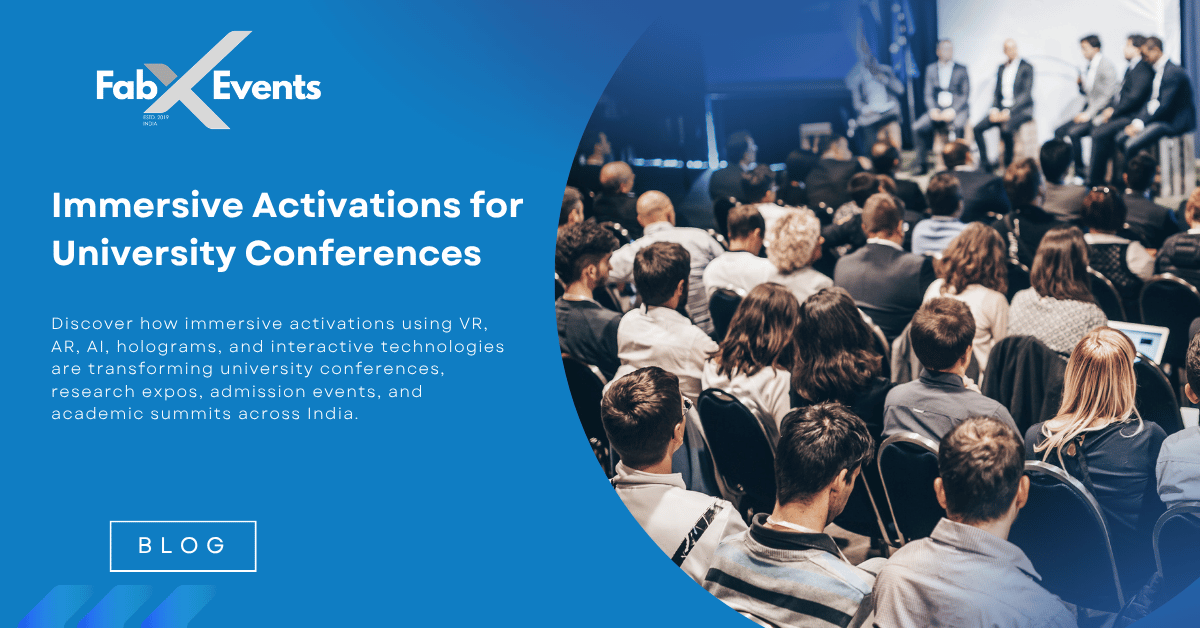
Immersive Activations for University and Academic Conferences
Discover how immersive activations using VR, AR, AI, holograms, and interactive technologies are transforming university conferences, research expos, admission events, and academic summits across India.
Immersive Activations for University & Academic Conferences: The Future of Learning, Collaboration & Campus Engagement
Universities and academic institutions have always been centres of knowledge, research, and innovation. However, as technology continues to reshape education, the expectations of students, researchers, faculty members, and industry partners are evolving just as quickly. Academic conferences, research expos, admission open houses, innovation summits, and annual university events are no longer viewed as platforms for presentations alone. They are becoming opportunities to create memorable, interactive experiences that inspire collaboration and showcase institutional excellence.
This shift has accelerated the adoption of immersive experiences powered by technologies such as Virtual Reality (VR), Augmented Reality (AR), Artificial Intelligence (AI), Mixed Reality (MR), interactive touch displays, holographic presentations, projection mapping, and digital simulations. Instead of passively listening to keynote speakers or viewing static displays, attendees can now explore research through immersive demonstrations, interact with digital prototypes, experience virtual laboratories, and participate in collaborative learning environments.
Across India, universities are investing in immersive activations not only to improve conference experiences but also to strengthen institutional branding, attract prospective students, encourage industry partnerships, and position themselves as future-ready centres of learning. Whether it is an engineering institute demonstrating Industry 4.0 technologies, a medical university offering virtual anatomy labs, or a business school showcasing AI-driven simulations, immersive technology is redefining how academic events engage their audiences.
This guide explores how immersive activations are transforming university and academic conferences, the technologies driving this change, and why institutions across India are embracing these experiences as part of their long-term event and education strategies.
What Are Immersive Tech Activations?
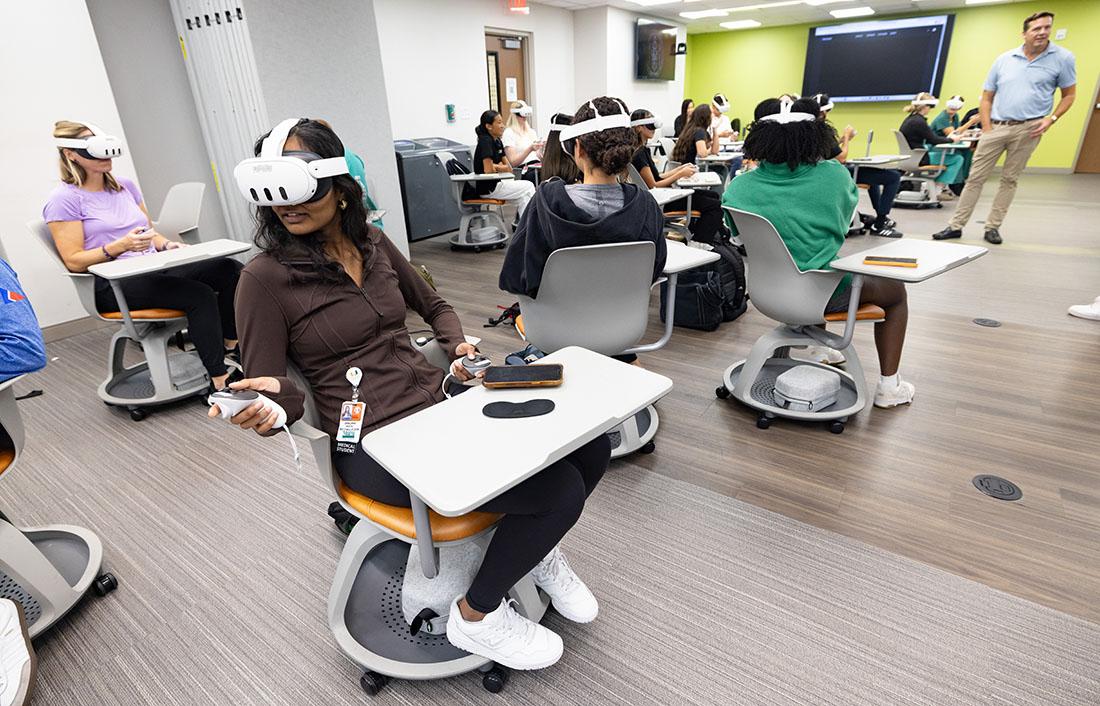
Immersive tech activations are technology-enabled experiences designed to encourage active participation rather than passive observation. Unlike traditional conference displays that rely on posters, brochures, or presentations, immersive activations invite attendees to interact directly with content, making learning more engaging, memorable, and impactful.
In the context of higher education, these experiences bridge the gap between theory and practice. Participants are not simply reading about a concept—they are experiencing it through virtual environments, interactive demonstrations, and intelligent digital systems.
For example, a student attending a renewable energy conference could explore the internal workings of a wind turbine using Virtual Reality. Architecture students might walk through an unbuilt campus using immersive 3D visualisations, while healthcare professionals attending a medical symposium could practise surgical procedures within realistic virtual simulations.
This hands-on approach makes complex subjects easier to understand while creating a more engaging conference environment for delegates, exhibitors, researchers, and industry experts alike.
Why Immersive Experiences Are Becoming Essential for Universities
Higher education institutions today compete on multiple fronts. Beyond academic excellence, universities are expected to demonstrate innovation, attract research funding, build industry collaborations, improve international visibility, and provide exceptional learning experiences.
Traditional conference formats often struggle to hold the attention of digitally connected audiences. Students and professionals increasingly expect experiences that combine technology, storytelling, and interaction.
Immersive Experiences help institutions achieve these objectives by creating environments where attendees actively engage with ideas instead of simply observing them. This results in stronger knowledge retention, increased participation, and more meaningful conversations between academia and industry.
For universities, immersive activations also strengthen institutional branding. Prospective students are more likely to remember a university where they explored a virtual campus, interacted with robotics demonstrations, or participated in an AI-powered innovation challenge than one where they only collected printed brochures.
The rise of social media has further accelerated this trend. Interactive installations naturally encourage visitors to capture photos and videos, extending the event's reach far beyond the venue through organic online sharing.
University Events That Benefit from Immersive Activations
Immersive technology can enhance almost every type of academic event, creating richer experiences for attendees while supporting institutional objectives.
Academic Conferences
Research conferences often involve highly specialised topics that can be difficult to communicate through slides alone. Immersive technologies allow presenters to visualise complex concepts in ways that are easier to understand and more engaging.
Imagine a climate science conference where delegates experience rising sea levels through Virtual Reality, or an engineering symposium where attendees interact with digital twins of smart manufacturing systems. Such experiences transform technical discussions into memorable learning opportunities.
Conference organisers can also incorporate VR Activations and interactive demonstrations to encourage networking and increase participation between sessions.
University Admission Open Houses
Open houses are among the most important recruitment events for educational institutions. Prospective students and parents want to understand not only academic offerings but also campus life, infrastructure, research facilities, and student experiences.
Instead of relying solely on brochures and guided tours, universities can use immersive experiences to provide virtual campus walkthroughs, laboratory demonstrations, hostel tours, and interactive faculty introductions.
Students can explore classrooms, innovation centres, libraries, sports complexes, and research laboratories from a single immersive activation zone, making the admission process far more engaging and informative.
Innovation & Startup Summits
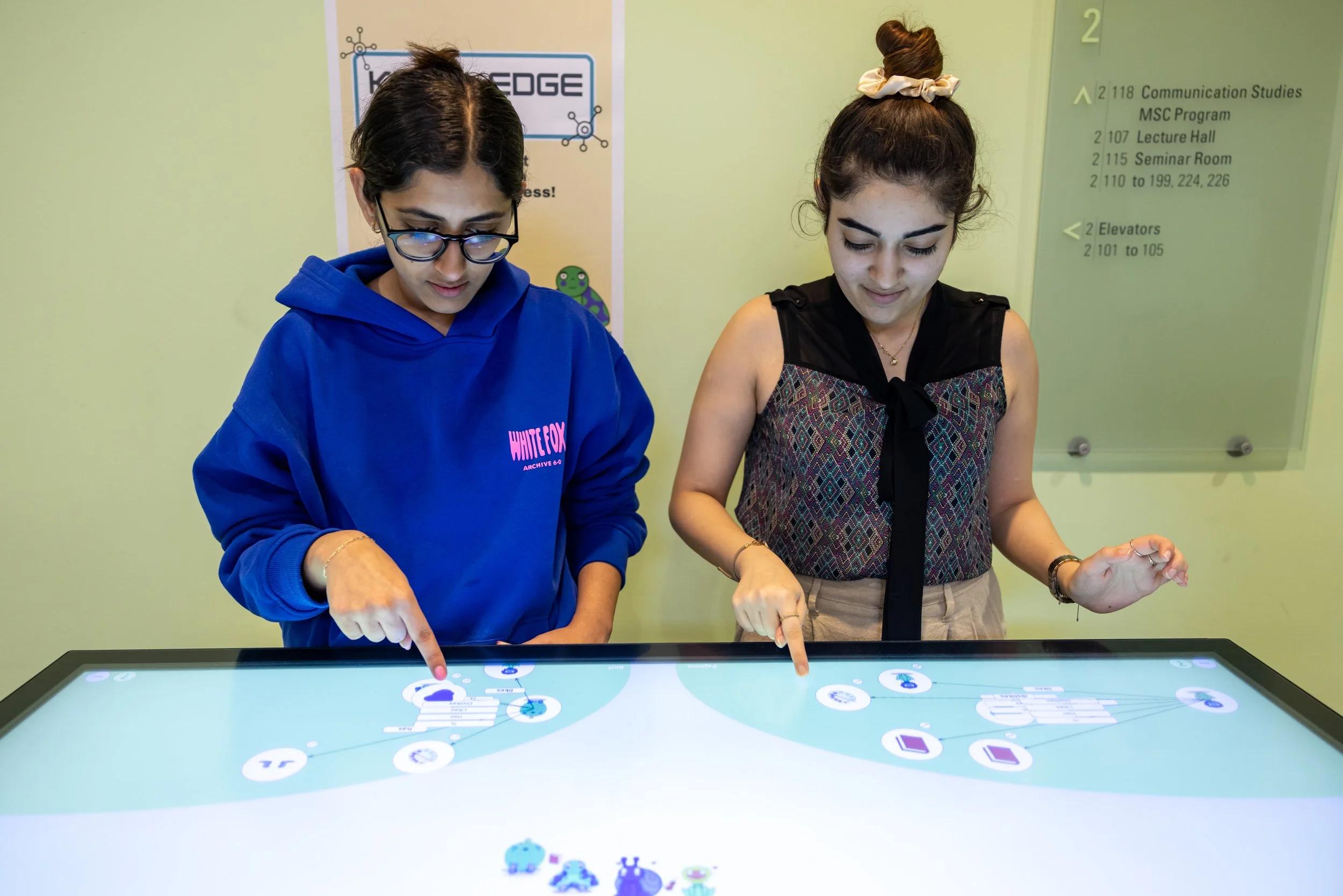
Many universities now organise innovation festivals where students present research projects, prototypes, startups, and emerging technologies.
Immersive activations elevate these events by enabling visitors to interact with robotics, AI applications, Internet of Things (IoT) solutions, smart city demonstrations, and digital engineering models.
VR Activations also allow startup founders to showcase products that may still be in development, providing investors and industry experts with realistic demonstrations without requiring physical prototypes.
Such experiences create valuable networking opportunities while helping institutions highlight their innovation ecosystem.
Convocations, Annual Festivals & Cultural Celebrations
Immersive technology is increasingly being integrated into ceremonial events as well.
Projection mapping can transform university buildings into storytelling canvases during convocation ceremonies. AI-powered photo booths create personalised graduation portraits, while holographic welcome messages add a futuristic touch to opening ceremonies.
Interactive digital guestbooks, social media walls, and immersive lighting experiences also encourage graduates, alumni, and families to actively participate in celebrations while generating memorable content for social platforms.
Research Expos and Faculty Showcases
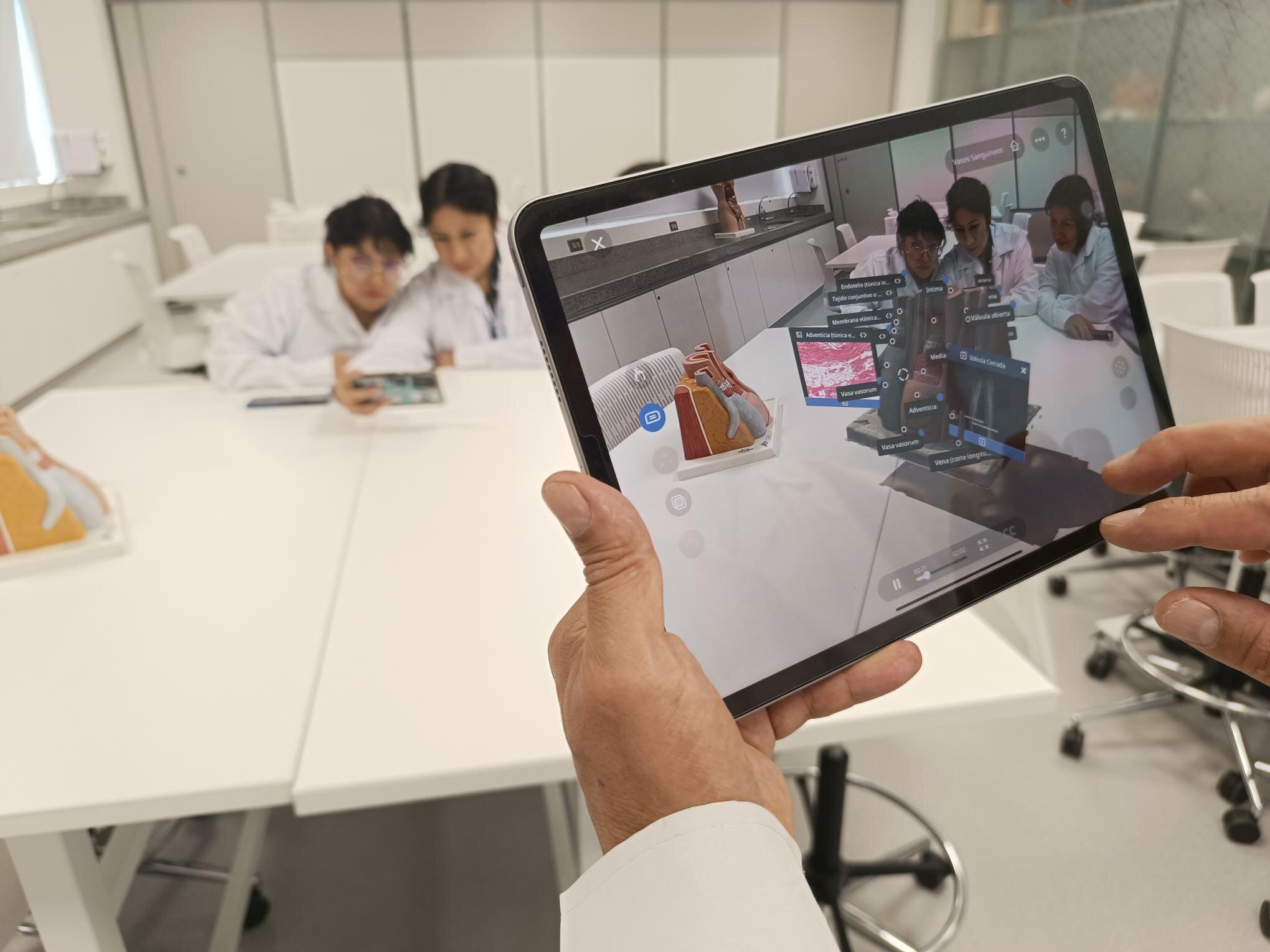
Research exhibitions have traditionally relied on printed posters and presentation boards. While informative, these formats often struggle to communicate highly technical work effectively.
Interactive touchscreens, Augmented Reality engineering models, Virtual Reality laboratory simulations, and holographic visualisations enable researchers to present their work in ways that are easier to understand and far more engaging.
Whether showcasing biomedical research, architectural designs, aerospace engineering, or environmental studies, immersive technologies allow visitors to experience research outcomes rather than simply reading about them.
Technologies Powering Modern Academic Conferences
The rapid advancement of immersive technology has provided universities with a wide range of tools that can be adapted to different event formats and learning objectives.
Virtual Reality has become one of the most widely adopted technologies for education-focused events. It enables realistic simulations, virtual laboratories, campus tours, engineering walkthroughs, medical training, and collaborative research demonstrations.
Augmented Reality complements physical environments by overlaying digital information onto real-world objects. Universities use AR for interactive textbooks, engineering prototypes, scientific visualisations, and campus navigation.
Mixed Reality combines physical and digital worlds, allowing users to interact naturally with holographic objects. It is increasingly used for design reviews, medical education, manufacturing demonstrations, and collaborative research projects.
Artificial Intelligence is transforming conferences through smart registration systems, AI-powered assistants, personalised recommendations, multilingual support, and intelligent networking platforms that help delegates connect with researchers sharing similar interests.
Interactive touch displays, digital twins, gesture-controlled installations, robotics demonstrations, holographic presentations, and projection mapping further expand the possibilities for creating memorable academic experiences.
Together, these technologies are reshaping how universities communicate research, engage students, and collaborate with industry partners.
How Immersive Activations Benefit Universities Beyond the Event
While immersive technologies certainly make conferences more engaging, their value extends far beyond the event itself. Universities investing in immersive experiences often discover that these technologies contribute to stronger branding, improved stakeholder engagement, and long-term institutional growth.
One of the most significant advantages is improved student engagement. Educational research consistently suggests that interactive learning environments improve participation and information retention compared to passive presentations. When students can explore a virtual laboratory, manipulate a 3D engineering model, or experience a scientific simulation through Virtual Reality, abstract concepts become far more accessible.
Immersive experiences also help universities strengthen their public image. Institutions that showcase emerging technologies at conferences and academic events position themselves as progressive, research-driven, and innovation-focused. This perception is valuable not only for attracting prospective students but also for building confidence among parents, industry partners, accreditation bodies, and funding organisations.
Another important benefit is increased visibility on digital platforms. Interactive installations naturally encourage attendees to capture photos and videos, creating authentic user-generated content that extends the event's reach across LinkedIn, Instagram, YouTube, and other social media platforms. For universities looking to improve brand awareness, immersive conference activations often become some of the most shared experiences during an event.
Strengthening Industry Collaboration Through Interactive Experiences
Universities are increasingly expected to bridge the gap between academic research and industry requirements. Conferences provide an ideal environment for these conversations, and immersive technologies make those interactions more meaningful.
Instead of presenting research through static posters or technical documents, faculty members and students can demonstrate their work using virtual simulations, interactive prototypes, or digital twins. This allows corporate visitors, investors, and research organisations to better understand complex concepts and evaluate their practical applications.
For engineering institutions, immersive demonstrations can showcase robotics, automation systems, and Industry 4.0 technologies. Medical universities can present anatomy simulations or surgical training environments. Architecture schools can guide visitors through virtual buildings before construction begins, while business schools can demonstrate AI-driven decision-making models.
These interactive demonstrations often generate deeper discussions, stronger networking opportunities, and potential collaborations that extend well beyond the conference.
Popular Immersive Activations for University Conferences
Every academic event has different objectives, but several immersive solutions have become particularly effective across universities and educational institutions.
VR Activations remain one of the most popular choices because they allow attendees to experience virtual laboratories, scientific simulations, industrial environments, campus tours, and collaborative learning experiences. They are equally effective for engineering conferences, medical symposiums, research expos, and admission events.
Augmented Reality demonstrations bring physical models to life by overlaying digital information, animations, and interactive content. Students can scan engineering components, scientific diagrams, or architectural drawings to access additional information instantly.
Interactive touch walls and digital kiosks allow visitors to browse research projects, academic programmes, innovation initiatives, and faculty achievements through intuitive interfaces that encourage exploration.
AI-powered experiences continue to gain popularity for registration, networking recommendations, multilingual support, virtual assistants, and personalised event experiences. These technologies improve operational efficiency while enhancing the attendee experience.
Projection mapping transforms university buildings, auditoriums, and stages into immersive storytelling environments during inaugurations, convocations, cultural festivals, and anniversary celebrations. Combined with synchronised lighting and sound, these experiences create memorable opening ceremonies and closing events.
Social Wall activations encourage students, alumni, researchers, and delegates to share their conference experiences online using dedicated event hashtags. Live social media displays increase audience participation while extending the institution's digital reach beyond the venue.
Industries That Participate in Academic Conferences
University conferences today bring together a wide range of industries that rely on innovation and research to drive future growth.
Education technology companies demonstrate smart classrooms, adaptive learning platforms, and digital assessment tools. Healthcare organisations showcase medical devices, telemedicine solutions, and virtual training platforms. Manufacturing companies present automation technologies, digital twins, robotics, and industrial simulations.
Artificial Intelligence companies demonstrate machine learning applications across education, healthcare, finance, and business. Space technology organisations present satellite systems, aerospace research, and planetary exploration initiatives. Defence research institutions increasingly use immersive simulations to communicate complex technologies safely and effectively.
Agriculture, renewable energy, sustainability, biotechnology, and smart city developers also benefit from immersive demonstrations because many of their innovations involve systems that are difficult to explain through conventional presentations alone.
For these organisations, immersive experiences simplify technical communication while creating memorable interactions with students, researchers, policymakers, and industry leaders.
Planning Successful Conference Activations
The success of an immersive academic conference depends not only on technology but also on thoughtful planning. Every activation should align with the event's educational objectives, audience profile, and available infrastructure.
The first step is identifying the purpose of the experience. Some conferences focus on student engagement, while others prioritise research collaboration, admissions, innovation showcases, or corporate networking. Understanding these goals helps determine the most appropriate technologies.
Venue planning is equally important. Sufficient space should be allocated for VR activity zones, interactive demonstrations, networking areas, and audience movement. Reliable internet connectivity, power availability, lighting conditions, and technical support should also be considered well in advance.
Content plays a critical role in creating meaningful immersive experiences. Rather than using technology for its own sake, successful activations focus on solving real communication challenges. A virtual laboratory should support learning outcomes, while an AI-powered information kiosk should genuinely improve visitor navigation and engagement.
Accessibility is another important consideration. Experiences should be designed to accommodate participants with different levels of technical familiarity and varying accessibility requirements, ensuring that all attendees can participate comfortably.
Why Universities Choose FabX Events
FabX Events helps educational institutions transform traditional conferences into interactive experiences that inspire learning, collaboration, and innovation.
Our team provides end-to-end immersive event solutions tailored specifically for universities, colleges, research organisations, and academic institutions across India.
Our services include:
- VR Activations for conferences and exhibitions
- Interactive research showcase experiences
- AR campus demonstrations
- AI-powered registration and engagement solutions
- Digital touch walls and smart kiosks
- Social Wall activations
- Projection mapping
- Interactive gaming and learning zones
- AI Photo Booths
- 360 Video Booths
- Holographic displays
- Digital wayfinding systems
- Gamified networking activities
Whether you are organising a national education summit, an international research conference, an engineering expo, a medical symposium, or an innovation festival, our solutions are designed to create memorable experiences that support both educational outcomes and institutional branding.
Final Thoughts
The future of academic conferences is no longer defined solely by keynote speeches, technical papers, or exhibition booths. Universities are embracing interactive technologies that encourage exploration, collaboration, and hands-on learning while creating memorable experiences for students, researchers, faculty members, industry leaders, and policymakers.
Immersive Experiences have become powerful tools for communicating complex ideas in accessible ways, strengthening institutional branding, supporting research commercialisation, and improving conference engagement. As India's higher education ecosystem becomes increasingly competitive, universities that integrate innovative technologies into their events are better positioned to attract talented students, establish meaningful industry partnerships, and showcase their commitment to innovation.
From VR Activations and AI-powered demonstrations to interactive research exhibits, projection mapping, and digital engagement platforms, immersive conference experiences are helping institutions redefine how knowledge is shared and experienced.
Whether you're organising a university admission event, an international research summit, an innovation expo, or a multidisciplinary academic conference, investing in well-planned immersive activations can transform an ordinary event into an inspiring learning experience that continues to create value long after the conference concludes.
Author Bio
Khushboo is a hospitality professional with over 12 years of experience and a degree in Hospitality. As the Corporate Sales Lead at FabX Events, She works closely with businesses, event organisers, and enterprises to provide the right technology rental solutions for conferences, exhibitions, training programmes, corporate events, and business projects. Passionate about technology and event innovation, Khushboo stays up to date with the latest hardware trends and shares practical insights, industry best practices, and expert advice through the FabX Events blog.
FAQs